Among the rolling hills of the Collio region, in Capriva del Friuli, there is a place unlike anywhere else in Friuli. It is not simply a winery, not simply a medieval castle, and not simply a golf course winding its way through the vineyards. It is all of these things at once, and none of them alone can fully explain what it feels like to arrive there.
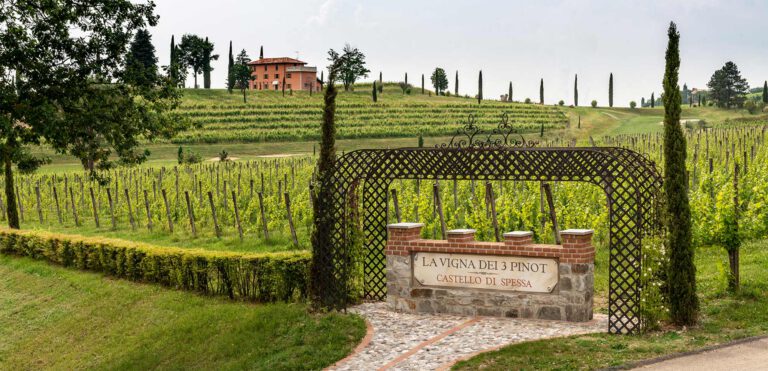
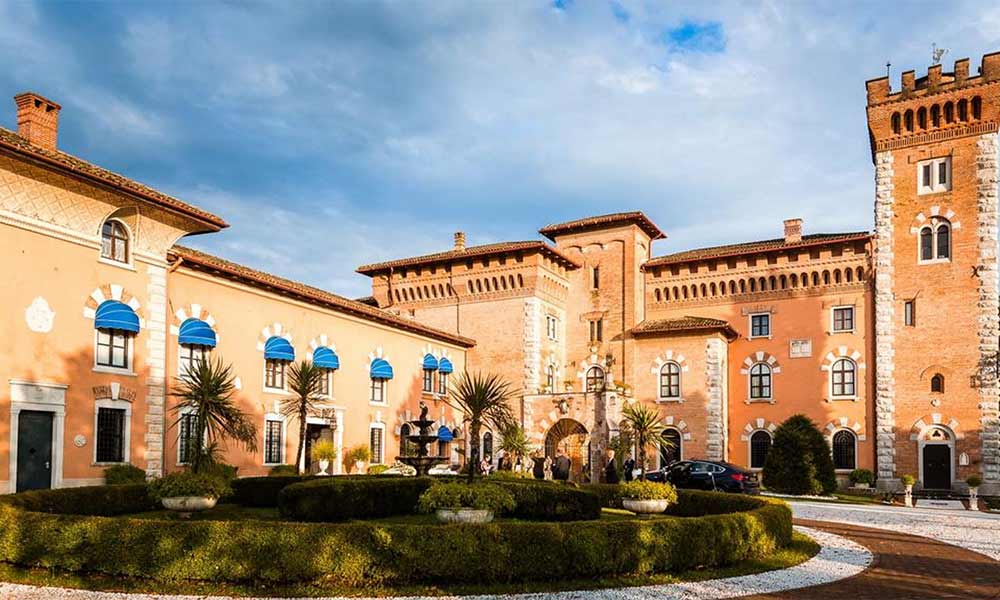
Castello di Spessa stands in the heart of the Collio region, in Capriva del Friuli. You can spot it from the road long before you arrive. It rises on a gentle hilltop, surrounded by an Italian-style garden and vineyards that descend in neat rows towards the plain below. Its origins date back to the thirteenth century, but the story that made it famous is much more recent — or rather, much more romantic.
Casanova was here
In 1772, Giacomo Casanova was in Trieste. There he met Count Luigi Torriani, the owner of Spessa, who invited him to his estate the following year. Casanova remained for several months and devoted several pages of his Mémoires — Histoire de ma Vie — to his stay, praising the wines of the estate and describing them, in his characteristically precise and baroque prose, as being “of excellent quality.”
This is not the kind of legend invented for a brochure. It is documented history, recorded by Casanova himself — the man who perhaps embodied the spirit of eighteenth-century Venice better than anyone else: a love of beauty, of wine, of conversation, and of places capable of living up to the imagination.
The connection with the Serenissima was no coincidence. The Collio formed part of the Venetian mainland territories, and the noble families of Friuli — the Dorimbergos, the Rassauers and the Della Torre Valsàssina family, who claimed descent from Charlemagne himself — were woven into the network of cultural and economic relationships centred on Venice. When Casanova arrived at Spessa, he was not a stranger. He was a Venetian returning to familiar ground.
The Wine That Bears His Name
The Pali family, who acquired the castle in 1987 and transformed it into a Golf Wine Resort & SPA, chose to honour that stay in the most direct way possible: by dedicating their flagship Pinot Noir to Casanova.
Casanova — a Collio DOC Pinot Noir — is produced from vineyards in Capriva del Friuli, rooted in ponca, the distinctive mix of marl and sandstone that defines the geology of the Collio. Fermentation takes place in truncated cone-shaped oak vats, with manual punch-downs carried out daily for 15 to 20 days. Then the wine descends, quite literally, into one of the most unusual places in Friuli.
Beneath the castle, 18 metres underground, lies a military bunker. It was excavated during the Second World War and only discovered in 1987, during restoration work. A constant temperature of 14°C, perfect humidity and complete silence. Today, this is where the Casanova spends 12 months ageing in barriques before being bottled unfiltered and given further time to mature in glass.
The result is a deep ruby-red wine, with aromas of red berries and spice on the nose, and a velvety, lingering palate. It is not the delicate, taut Pinot Noir of Burgundy, but something with a more southern character — warm, enveloping and persistent, with notes of blackberry and sweet spice that linger long after the last sip.
What to Do at Castello di Spessa
A visit to the castle is not something to be rushed. The ideal time to arrive is in the late afternoon, when the light falls at an angle across the vineyards and the hills of the Collio take on that golden-green glow that is impossible to capture properly in a photograph and impossible to forget.
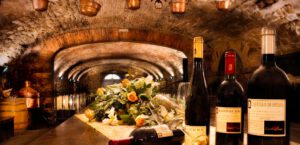
The medieval cellars — the oldest in the area — can be visited by appointment, with a tasting of the estate’s wines included. It is an opportunity to understand what terroir really means in a place like this: not a piece of sommelier jargon, but a tangible reality shaped by soil, microclimate and history.
The resort also offers the chance to stay overnight in rooms within the castle itself — some decorated in eighteenth-century Venetian style, and one suite, unsurprisingly, named after Casanova. Alternatively, there are apartments set among the vineyards, more rustic and secluded, ideal for a weekend of digital detox surrounded by the vines.
Golf enthusiasts will find an 18-hole course woven through the vineyards in a way that feels entirely unique. It is often difficult to tell where the golf course ends and the estate begins.
And if you choose to stay for dinner, La Tavernetta al Castello is one of the Collio’s most accomplished gourmet restaurants, with a cuisine deeply rooted in the local territory — regional meats, wild herbs and Friulian cheeses — paired with wines from the estate’s own cellars.
Before You Leave: Understanding the Collio
Castello di Spessa is not an isolated destination. It lies in the heart of a region — the Collio of Gorizia — that is perhaps Friuli’s most compelling wine district and one of Italy’s least known. Just a few kilometres away, towards Cormons, you will find many of the area’s historic wineries.
If you have a full day, you can do both: spend the morning in Cormons exploring the great white wines of the Collio, then head to Capriva in the afternoon for a visit to the castle and a glass of Casanova as the sun sets behind the Julian Prealps. It is the kind of day that stays with you long afterwards.
To plan your visit to Castello di Spessa — including a wine tasting in the cellars and the underground bunker — read our guide: Wine Tasting at Castello di Spessa: Wine, History and a Secret Bunker.
A morning among these vineyards is unlike any standard tourist experience. There are no queues, no organised groups. Just the landscape, the silence, and the chance to meet the people who actually make the wine.
What to Do in the Collio
The Collio is, first and foremost, about wine. But it is also a place shaped by history, shifting borders and cultures that have blended over centuries. Here, Italy ends and Slovenia begins — and that is not merely a geographical fact. It is reflected in the flavours, the languages and the traditions that define this corner of Europe.