There is an inscription on a building in Piran that tells you almost everything you need to know about the town. Carved into the stone façade of a fifteenth-century palace, it reads in old Venetian dialect: lassa pur dir — let them talk. The words were commissioned by a Venetian merchant who had fallen in love with a local girl and did not want the gossip of neighbours to trouble her. It was the fifteenth century. Venice had already ruled these shores for a hundred years, and would continue to do so for another four centuries.
That inscription is still there today, on the façade of the Venetian House overlooking Tartini Square. And it remains perfectly legible — written in a dialect that, here on Slovenia’s Adriatic coast, feels at once familiar and distant.
A Town That Doesn’t Feel Like Slovenia
Piran can be reached from Trieste in less than an hour, following a road that skirts the Gulf before descending towards Slovenia’s Adriatic coast. Thirty-seven kilometres, one border, and a world that changes — though perhaps not as much as you might expect.
The municipality is bilingual: both Slovene and Italian are official languages. You can order a coffee in Italian, and street names appear in both languages. The architecture tells the rest of the story on its own — Venetian Gothic palaces, Baroque churches and narrow lanes paved with Istrian stone. Piran’s relationship with the Serenissima began in the thirteenth century, founded on the economic importance of the salt trade, and lasted for more than five hundred years.
When you enter the town — on foot, because cars are not allowed into the historic centre — the first thing you see is the harbour. The mandracchio, the old fishing port, with its moored boats and small restaurants looking out over the water. Then the streets begin to narrow, the houses rise higher around you, and suddenly the space opens onto Tartini Square.
What to See in Piran: Tartini Square and the Venetian House
At the centre of this elegant elliptical square paved in white Istrian stone stands the statue of the celebrated violinist Giuseppe Tartini, who was born here in 1692. Tartini is Piran’s most famous son — a composer, virtuoso violinist and music theorist whose reputation spread across Europe. He studied in Padua, performed throughout the continent, yet always maintained a connection with his hometown. His birthplace still overlooks the square today and has been converted into a museum dedicated to his life and work.
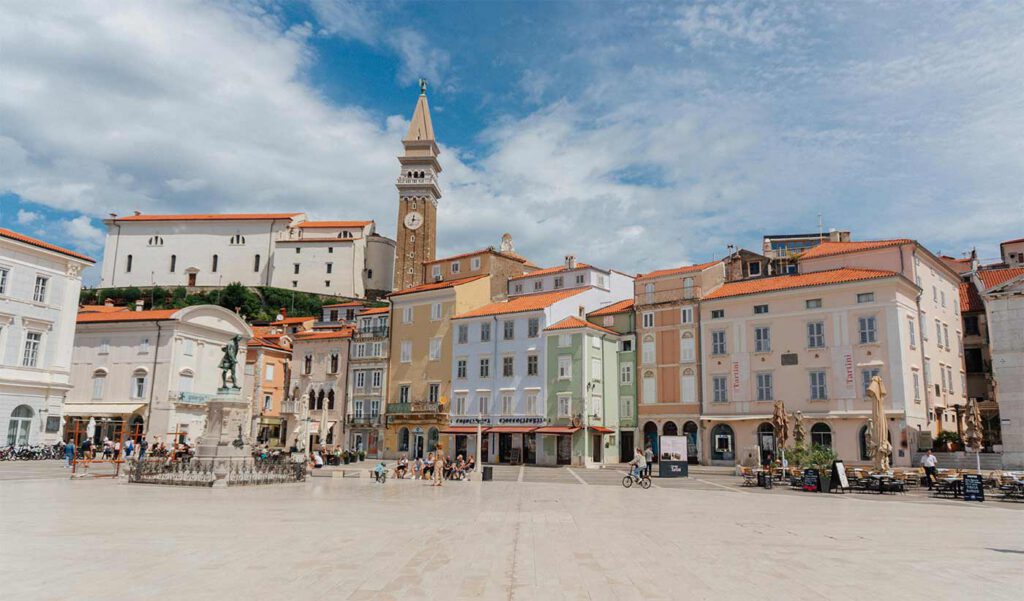
Around the square, the buildings tell the story of five centuries of Venetian rule. The Town Hall still bears the coat of arms of the Serenissima on its façade — a small detail that speaks volumes about a domination whose presence remains tangible in the town’s architecture. And then there is the Venetian House, the oldest surviving building on Tartini Square, dating back to the fifteenth century and widely regarded as the finest example of Venetian Gothic architecture in Piran. It is here that the inscription can still be found: lassa pur dir. A love story, a challenge to the town gossips, carved into stone and preserved for six hundred years.
The Bell Tower Facing Venice
From the centre of the square, you can already see it rising above the town on the hilltop: the bell tower of the Church of St George. Standing just over 47 metres high, it was built during the Venetian period and modelled on a smaller scale after the Campanile of St Mark in Venice. This was neither a coincidence nor a generic tribute. It was a deliberate statement of belonging — a way of declaring to anyone arriving from the sea that this was a Venetian town.
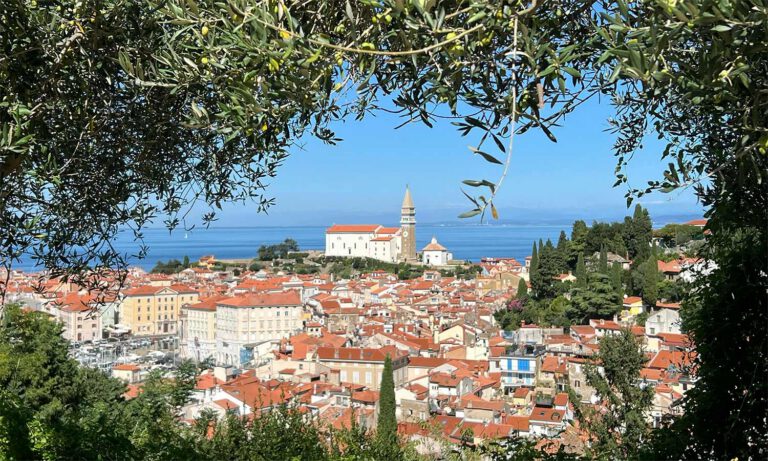
To reach the church, you climb through narrow alleys, past tightly packed houses and stone stairways. The climb is worth every step. From the terrace in front of the church, it is possible to see Trieste, the Alps and even the Dolomites when the sky is clear. And below, the town stretches out towards the sea like an open hand: red rooftops, the elliptical square, the harbour and the lighthouse at the tip of the headland.
The interior of the church preserves works from the Venetian school. The painting depicting the Martyrdom of Saint George is the largest oil on canvas in Slovenia. Few people know it. Few stay long enough to discover it.
The Walls and the Sunset
Before heading back down, it is worth walking along the medieval walls. Dating from the late fifteenth century, they extend for around 200 metres and are punctuated by seven towers, connected by walkways that offer sweeping views across the rooftops of the town, all the way to the harbour and the lighthouse.
From here, the perspective changes once again. Piran is not Venetian only in its architecture — it is Venetian in the way it uses space, in its relationship with the sea, in the density of its historic centre clustered on a headland as narrow as a galley. It is a town that the Venetians built in their own image, in a place that should have been a periphery and instead became a jewel.
From up here, as the sun sinks over the Gulf of Trieste and the lights of the town begin to glow one by one, the sunset is one of those things that are hard to describe and impossible to forget.
If you want to stay overnight in the historic centre, right on Tartini Square, Art Hotel Tartini is an ideal base — rooms overlooking the square, just a short walk from everything worth seeing. And if you have a full day to spare, the From Trieste to Piran itinerary also takes in Muggia and the Italian border — another chapter of the same story.