There is one material that connects Venice and Istria more deeply than any treaty or border ever could. It is not wine, nor salt. It is Istrian stone — a pale limestone that emerges throughout the Istrian hinterland and, for centuries, became the preferred building material of the Serenissima.
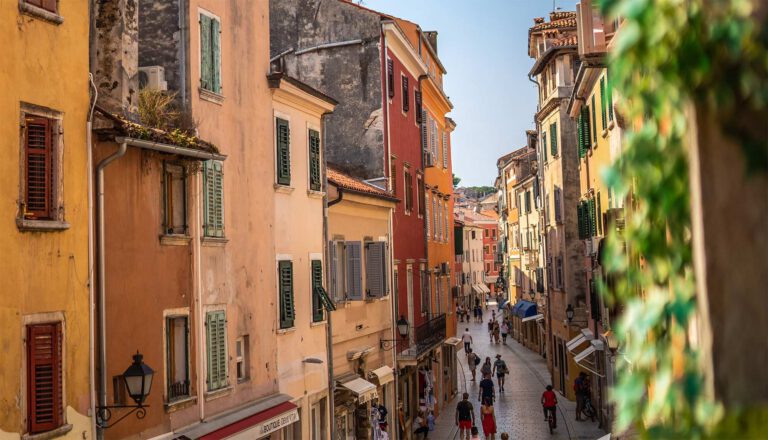
If you walk through Venice and run your hand along the doorway of an ancient palace, the columns of a church, or the steps of a bridge, you are touching Istria. That stone came from here — from the quarries of Rovinj, Bale and Vrsar — loaded onto sailing ships and transported to the foundations of a city built without solid ground beneath its feet. Istrian stone does not decay in salt water. It does not crumble. It withstands time better than marble. For a city built on water, it was the obvious choice — and the Venetians knew it well.
Istrian Stone and the Landscape That Shaped It
The Istrian hinterland that produces it is one of the Adriatic’s most overlooked regions. Medieval villages perch atop hills of white stone, narrow roads wind their way towards remarkably well-preserved historic centres, and a deeply rooted local cuisine blends Venetian, Slavic and Central European influences without any one tradition ever truly dominating the others.
Grožnjan — known in Italian as Grisignana — became a village of international artists in the 1970s, home to chamber music festivals and creative residencies. Yet long before that, it was a Venetian stronghold guarding the inland routes, and its white-stone streets still tell that story more vividly than any modern sign ever could. In summer, the village fills with visitors; out of season, it is almost deserted, and in that silence it becomes easier to imagine what it once was.
Motovun — known in Italian as Montona — overlooks the Mirna Valley from a hilltop that seems lifted straight from a Flemish painting. Its Venetian walls remain intact, and the Lion of Saint Mark still stands above the main gate. Below, in the forests that descend towards the river, grow the white and black truffles that have made this region famous across Europe — less renowned than those of Alba, perhaps, but no less prized, and considerably more affordable.
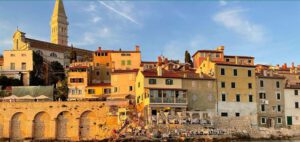
Rovinj is perhaps the most Venetian city beyond the lagoon. The bell tower that rises above the old town is an almost exact replica of Saint Mark’s Campanile — built by the same craftsmen and using the same stone. Narrow streets climb towards the Church of St Euphemia, the harbour opens onto the Adriatic, and in some families the Rovinj dialect, a Venetian linguistic heritage, is still spoken today, having survived every change of flag and government.
Following the Stone
This itinerary follows the stone. Not in the literal sense of visiting the quarries — although that is certainly possible — but by exploring a landscape shaped by the material itself: the rural architecture of traditional farmhouses built from Istrian limestone, the dry-stone walls that divide olive groves, and the historic centres where every building shares the same pale grey-white hue that shifts with the changing light. At dawn, the stone appears almost silver. By midday, it becomes dazzlingly bright. And at sunset, it takes on a warm, golden glow that recalls the palaces of Venice as the sun sinks over the lagoon.
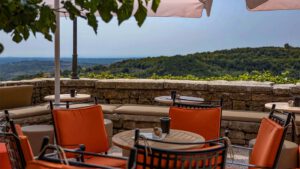
The region offers much more than stone. It is home to some of Croatia’s finest olive oils, a growing number of natural wines attracting international attention, and a seafood tradition in Rovinj that rivals far more celebrated coastal destinations. Konoba Batelina in Banjole serves the daily catch landed by the Skoko family — humble, often overlooked species that are rarely found even in local fish markets. Ristorante Puntulina, meanwhile, is built quite literally on the rocks above the sea, with views that alone are worth the journey.
When to visit
The best time to visit is in May and June, or from September to October. Summer can be crowded, particularly in Rovinj. Out of season, inland Istria feels almost entirely your own. Prices are lower, restaurants have more time for their guests, and the light is exactly right for understanding why this stone crossed the Adriatic for centuries to help build a city like Venice.
Three days is just enough time to understand it. You may find yourself wishing for a fourth.
Find the complete route in The Lands of White Stone itinerary.