The Lands of White Stone
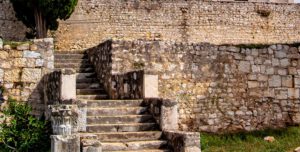
Inland Istria is built of white stone — limestone, the same rock that Venice extracted from these hills for centuries to build its palaces. To follow this territory is to follow a material: the dry-stone walls of the olive groves, the facades of medieval villages, the stairways worn by time. Grožnjan, Motovun, Rovinj — three places that tell, each in its own way, what it meant to be part of the Republic when stone was as valuable as salt.
The Stops
Grožnjan and the Venetian Hinterland
The first day is devoted to the heart of inland Istria. Grožnjan is one of the best-preserved Venetian fortified towns in the region: its walls, the Lion of St Mark above the gate, and white-stone lanes that are almost deserted outside the tourist season. In the 1970s, the village was revived by artists and musicians, and that unique blend of medieval stronghold and creative community remains intact today. Artegnana 1798 is the perfect base for the first night — a historic residence in the heart of the village, with a terrace overlooking the Istrian countryside.
In the evening, dinner at Konoba Morgan in Brtonigla: Istrian truffles, handmade pasta and a cuisine that owes little to tourism and everything to the land.
Motovun and the Mirna Valley
Motovun is perhaps the most photographed hilltop town in inland Istria, and for good reason: its Venetian walls remain intact, the Lion of St Mark still stands above the main gate, and the view across the Mirna Valley is exactly what you would expect from a Flemish painting.
Lunch is at Konoba Mondo, just below the fortress — authentic Istrian cuisine, firmly rooted in the local territory.
In the afternoon, stop at Ipsa Winery in Livade, where extra virgin olive oil and natural skin-contact wines are produced using traditional methods. It is a producer firmly rooted in local tradition, in a region that is steadily attracting international attention. Livade is also Istria’s truffle capital — just a few kilometres away lie the forests of the Mirna Valley, where both the prized white and black Istrian truffles are hunted.
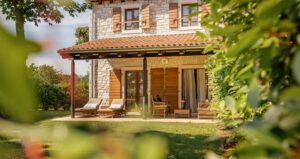
The second night is spent at Meneghetti Wine Hotel in Bale — a historic estate built of white Istrian stone, with its own winery, olive mill and rooms that feel as though they have always belonged to the landscape. It is the perfect place to understand the essence of traditional Istrian rural architecture.
Rovinj
The final day is devoted to Rovinj — the most Venetian town outside the lagoon. The bell tower of St Euphemia is an almost exact replica of St Mark’s Campanile, built by the same craftsmen using the same stone. The narrow streets of the old town climb towards the church, while the harbour looks out across the open Adriatic.
The morning is for walking — through the old town, up to the church, and down to the sea. Lunch at Ristorante Puntulina brings the journey to a fitting close: perched on the rocks above the water, it serves Venetian and Istrian cuisine with a view that alone is worth the trip. If you want to extend the day, Konoba Batelina in Banjole — just a short drive from Rovinj — is an unforgettable dinner stop. The Skoko family serve the day's catch, landed by their own boats, including lesser-known local fish that you are unlikely to find even at the market elsewhere.
Practical Information
The itinerary is best traveled by car. Distances are short — between Grožnjan, Motovun, and Rovinj, you never exceed 40-50 km.
The best time to visit is September-October for truffles and the grape harvest, or May-June for the light and the lack of summer crowds.
Experiences on this itinerary
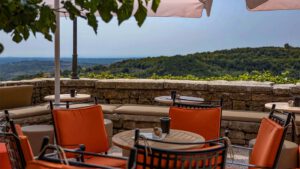
Artegnana 1798: A Historic Residence in Istria's Last Venetian Fortress
Stay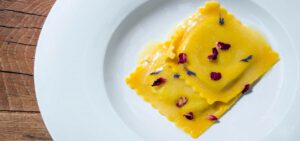
Konoba Morgan: Game, Truffles and a Son Who Plays the Flute at the End of the Evening
Food & Wine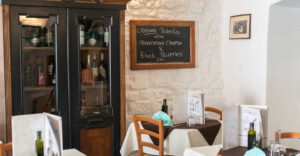
Konoba Mondo: Truffles, Boškarin and Anthony Bourdain's Photo by the Door
Food & Wine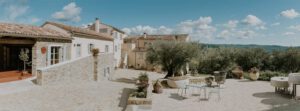
Ipša: Olive Oil, Wine and Truffles in the Village Where the Forest Smells of Istria
Food & Wine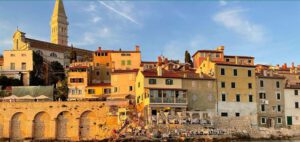
La Puntulina: The Family Home They Refused to Sell, by the Sea in Rovinj
Food & Wine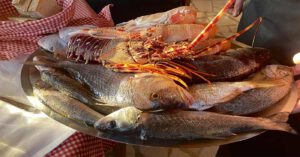
Konoba Batelina: They Fish in the Morning, They Cook at Night
Food & Wine