The Timber Route: From Carnia’s Forests to the Venetian Arsenal
Venice had no forests of its own, and for centuries it went looking for them in the mountains of its domain. Carnia was one of its reserves: timber was felled, floated down the mountain streams, lashed into rafts on the Tagliamento and carried towards the plain and the lagoon, alongside the timber that came down from Cadore on the Piave. From that wood Venice built the galleys of its Arsenale, the floors of its palaces and the piles beneath its foundations. This itinerary follows that route in reverse—from the mountains to the lagoon—through the forests of Carnia, the medieval village of Venzone, the mosaic town of Spilimbergo, the Friulian countryside, and finally Venice.
The Stops
Tolmezzo and the Carnia
Base: Albergo Diffuso Tolmezzo
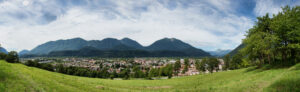
Tolmezzo is the historic capital of Carnia, seat of the gastaldo who granted the water rights needed to float timber downstream. The Museo Carnico delle Arti Popolari «Michele Gortani» tells the story of the mountain communities whose way of life sustained the economy of the Serenissima for centuries. In the afternoon, take a walk through the forests surrounding the town to experience it for yourself — these vast, silent woodlands that, even today, stretch for dozens of kilometres in every direction.
Venzone
Twenty minutes south of Tolmezzo, following the course of the Tagliamento River, you reach Venzone — the medieval town that Friuli rebuilt stone by stone after the devastating earthquake of 1976. The Gothic-Venetian Town Hall, crowned by the Lion of St Mark, is a reminder that Venice left its mark here too. The Cathedral, the town walls, the mummies in the Chapel of St Michael and the ruins of the Church of St John the Baptist — deliberately left in ruins as a memorial — make Venzone one of Friuli’s most powerful and moving places.
Spilimbergo and the Town of Mosaics
From Venzone, the route descends towards the plain, following the Tagliamento River to Spilimbergo. From the sixteenth century, mosaic and terrazzo craftsmen from this area worked on Venetian building sites, laying seminato floors with stones gathered from the gravel beds of the Meduna and the Tagliamento — another journey along the same route once travelled by the timber. The Friuli Mosaic School, founded in 1922, is open to visitors from Monday to Friday. You can watch students at work in the workshops, practising the same craft with the same gestures that have been passed down for five centuries.
The Friulian Lowlands
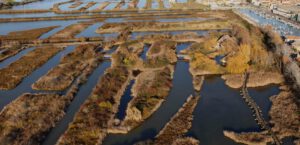
The fourth day is the slowest: a crossing of the Bassa friulana, the flat green plain that stretches between the rivers, dotted with quiet villages, until the land begins to dissolve into water. At Marano Lagunare, Friuli meets the lagoon, in a fishing village that for centuries was a Venetian outpost. A boat trip among the channels and fishermen's huts of the Marano lagoon is the right way to leave Friuli behind before reaching Venice.
Venice
The journey ends in the Venetian Lagoon. A traditional Venetian rowing lesson with Row Venice — using the same wooden boats that have navigated these canals for centuries — brings the story of the route to a fitting close. The timber of Carnia has become a boat. In the evening, dinner at Gatto Nero in Burano: lagoon cuisine, risotto di gò, and the quiet charm of the island outside the tourist season.
Practical Information
The itinerary is best explored by car.
From Tolmezzo to Venice is about 150 km via the A23 and then the A4. But this is an itinerary to be savoured slowly, with plenty of stops and no rush.
The best time to visit is September and October, when the forests of Carnia are ablaze with autumn colours and the lagoon still enjoys the light of late summer.
Experiences along the route
Albergo Diffuso Tolmezzo: Stay in the Carnia That Supplied Venice's Arsenale
enogastronomia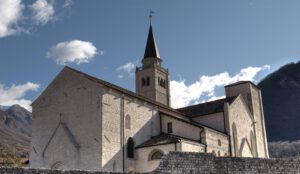
Venzone: The Medieval Village Rebuilt Stone by Stone
enogastronomia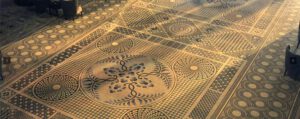
Scuola Mosaicisti del Friuli: Where Venice's Mosaic Floors Were Born, on the Banks of the Tagliamento
enogastronomia
Row Venice: learn Venetian rowing with the women keeping Venice alive
culture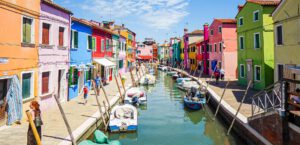
Trattoria Al Gatto Nero: the lagoon cuisine Burano has always kept to itself
Food & Wine