In some of Carnia’s forests, the ones that now belong to the Consorzio Boschi Carnici, the Republic set boundary stones marked with two letters, CX, the cipher of the Council of Ten. These were the boschi banditi, forests closed to local use and reserved, in the words of a document of the time, «per uso et bisogno della Casa dell’Arsenal», for the use and needs of the Arsenale, above all for oars, masts and yards. Venice was a city without forests of its own, and for centuries it went looking for timber in the mountains of its mainland domain, bringing it down to the lagoon along the rivers.
Where did Venice’s timber come from?
Venice drew its timber from an arc of mountains and hills that stretched from Trentino to Istria. Conifers, Norway spruce and larch, came down from the Alps of the Venetian domain: from Cadore along the Piave, from Carnia and Friuli along the Tagliamento, from Primiero along the Cismon and the Brenta. Oak for keels and frames came from lowland and hill forests, the Montello above all, while beech for oars came from the Cansiglio forest. When that was not enough, the Republic turned to the forests of Istria and imported oak from Dalmatia.
The numbers show the scale of the problem. According to the forest historian Mauro Agnoletti, a sixteenth-century galley was built from roughly 55% oak and the rest conifer, and even in its best years the Venetian mainland never supplied more than about 20,000 cubic metres a year of timber fit for shipbuilding, far short of what the Arsenale needed.
| Forest | Wood | What it was used for | Route to the lagoon |
|---|---|---|---|
| Cadore | Spruce, larch | Beams, planks, foundation piles, masts and yards | The Piave, floated and rafted |
| Carnia and Friuli | Fir, larch | Planks and beams; oars and masts from the reserved forests | Carnic mountain streams, then rafts on the Tagliamento |
| Primiero and Agordino | Fir | Beams and planks | The Cismon and Brenta; the Cordevole and Piave |
| Cansiglio | Beech | Galley oars | The Piave |
| Montello | Oak | Keels and ship frames | The Piave |
| Istria (the Forest of St Mark at Motovun) | Oak | Shipbuilding | By sea |
A city built on wood
Venice stands on a forest of piles driven into the mud of the lagoon. In the oxygen-poor sediments those trunks have survived for centuries, and many of the ones floated down from Cadore along the Piave are still there, beneath churches, palaces and quaysides. Timber also went into floors, ceilings and furniture, and above all into ships.
The hungriest consumer was the Arsenale. Tradition dates its founding to 1104, under Doge Ordelafo Falier, although no document supports so precise a date; it certainly existed by the early thirteenth century, and from 1320, with the Arsenale Nuovo, it became a true production site. In the early sixteenth century it employed, by the most widely quoted estimate, some 16,000 people, organised in stages that historians compare to an assembly line. Its most famous story belongs to the visit of Henry III of France in 1574, when a galley was supposedly fitted out in the time it took him to dine: a show of strength staged for a king rather than a measure of ordinary output.
Timber floating: the menàus and the raftsmen
Getting logs from the mountains to the lagoon took more than one trade. On the upper streams the timber travelled loose, carried by the current: this was the menada, and in Carnia the men who escorted it were called menàus, the menadàs of the Piave valleys. Working in teams, they prepared the riverbed by fixing logs wherever timber was likely to jam, guarded the passage, and freed stranded trunks with a long hooked pole, the anghîr, lowering themselves on ropes into the narrowest gorges. By the calculations reported by the historian Giorgio Ferigo, a menada advanced little more than two kilometres a day.
Where the water was too shallow, they built stue, dams of logs and stones that held back a reservoir and then released it all at once in an artificial flood. At the stua between Ampezzo and Sauris, between 27 June and 1 August 1755, the keeper counted almost four thousand logs belonging to a single partnership of merchants. Further down, at river ports such as Portis, where the Fella joins the Tagliamento, the timber was sawn or lashed into rafts and steered towards the plain by the raftsmen.
The eighteenth-century account books of a timber business in Mione also show who did this work. Most of the woodcutters in Carnia were not Carnic at all: they came from the Canal del Ferro, from Tramonti and from Comelico, while the Carnic men themselves left as seasonal migrants.
Carnia and the Republic’s forests
From the mid-fifteenth century the Republic surveyed the oak forests its fleet depended on, counting and measuring them tree by tree, and magistracies such as the Provveditori alle legne e boschi set the minimum diameter below which a tree could not be felled. In Carnia, though, most timber passed through the hands of merchants, Carnic, Friulian and Venetian, who bought standing lots, had them felled and sawn, and sold the wood in the markets of the plain and of Venice. The reserved forests were kept for the Arsenale.
The administrative centre was Tolmezzo, the historic capital of Carnia, where the gastaldo granted the water rights needed to float timber downstream. Today, in Palazzo Campeis, the Museo Carnico delle Arti Popolari «Michele Gortani» tells the story of the valleys that timber came from, and the Albergo Diffuso Tolmezzo makes a natural base.
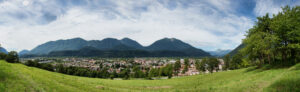
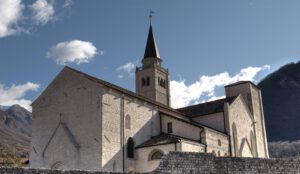
Further down the Tagliamento lies Venzone, a walled town on the old road from Aquileia to Noricum, which became part of the Republic of Venice in 1420 along with most of Friuli. Its sixteenth-century Palazzo Orgnani-Martina houses a permanent exhibition devoted to the forest itself, «Foreste, Uomo, Economia nel Friuli Venezia Giulia».
The mosaic makers and the stones of the Tagliamento
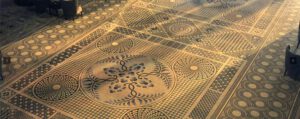
Another raw material travelled along the same river. From the sixteenth century, terrazzo and mosaic craftsmen from western Friuli, from Sequals, Fanna, Arba, Cavasso and Spilimbergo, are recorded on Venetian building sites, laying the speckled floors still known as seminato alla veneziana. Their material came from the gravel beds of the Meduna and the Tagliamento, a supply of stones in every colour on their doorstep. The tradition lives on at the Scuola Mosaicisti del Friuli, founded in Spilimbergo in 1922.
The other half of this story came by sea: Istrian stone, from which Venice built its quays, steps and façades.
What remains
Timber floating faded slowly in the twentieth century as roads and railways arrived. On the Piave the decline began with the train, which reached Perarolo in 1913, and the last menada on the Boite took place in 1942; in Carnia, on the Degano, timber was still coming down by water in the 1960s, as Umberto Candoni’s photographs show. The forests are still there, and the Tagliamento is considered the last Alpine river whose course remains morphologically intact, its wide braided bed never straightened.
The Timber Route itinerary follows this story over five days, from Carnia to the lagoon along the Tagliamento.
Sources and further reading
- Mauro Agnoletti, Arsenale e risorse forestali: contesti storici e proposte museali, Insula Quaderni (in Italian)
- Giorgio Ferigo, Boscadôrs, menàus, segàts, çatârs. La filiera del legno nella Carnia del Settecento, in F. Bianco, A. Burgos, G. Ferigo, Aplis. Una storia dell’economia alpina in Carnia, Consorzio Boschi Carnici, Tolmezzo 2008 (in Italian)
- Massimo Spampani, Dalle Dolomiti fino a Venezia: l’epopea degli zattieri del Piave, Montagna.tv, 2025 (in Italian)
- FAI, La faggeta da remi del Cansiglio o Boschi della Serenissima (in Italian)
- Comune di Venzone, Archivio storico (1457-1975), introductory notes (in Italian)
- Italia.it, Venzone
- Wikipedia, Venetian Arsenal and Tagliamento