What to See in Marano Lagunare? Start with the sign at the entrance.
Beneath the town’s name, in smaller lettering, are the words: “Maran, a Venetian-speaking community.” Not Friulian. Venetian. In a town in Friuli Venezia Giulia, sixty kilometres from Venice, people still speak a dialect of Venetian origin that has little in common with the Friulian spoken throughout the surrounding countryside.
That is how Marano introduces itself — with a quiet assertion of identity engraved on a roadside sign. A small statement, perhaps, but one that tells you almost everything about the place before you have even entered the town.
What to See in Marano Lagunare: The Square and the Tower
Marano has been inhabited since Roman times, but the character it wears today was largely shaped during centuries of Venetian rule, still visible in the architecture of its streets and squares. Venice maintained it as a military outpost on the Friulian Lagoon — one of the oldest lagoons in the Mediterranean — and gradually remade it in its own image: narrow calli, intimate campielli, wells carved from Istrian stone, and buildings with the distinctive arcades that define so many Venetian towns.
The heart of the town is Piazza dei Provveditori — named after the Venetian officials who governed the mainland territories of the Republic. Here stand the Loggia Maranese and the Millenary Tower, a 32-metre structure once used as a watchtower overlooking the lagoon. The name of the square says it all: here too, as throughout Marano, Venice left its mark not only on the architecture, but on the very language of the town itself.
The tower is the symbol of the town. You can spot it from afar, climb to the top, and from there understand exactly why the Venetians valued this place so highly. The lagoon stretches in every direction, channels weave their way through the salt marshes, and the boundary between land and water becomes so blurred that it is difficult to tell where one ends and the other begins.
The lagoon
This close relationship with the lagoon has shaped the local economy, which remains deeply connected to fishing, as well as a cuisine that carries the unmistakable flavours of the sea. Marano is not a tourist town — it is a fishing town that receives visitors with a certain indifference. The harbour at first light, as the boats return and fishermen unload their catch, is one of those scenes that exists entirely for itself, not for the people who come to watch it.
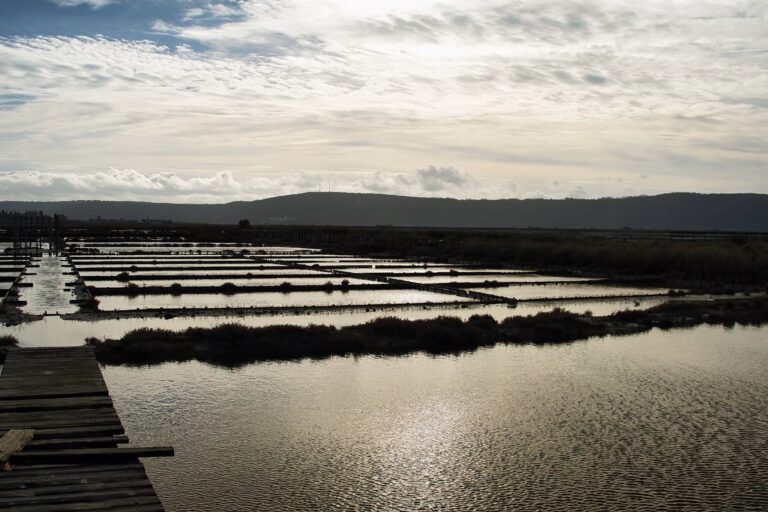
A boat excursion through the lagoon is the best way to understand this landscape. The Valle Canal Novo Nature Reserve protects 121 hectares of lagoon habitat, including a former fishing valley, stretches of brackish water and areas of surrounding countryside — a rich and varied ecosystem shaped by wetlands and tidal flows.
The traditional casoni — ancient reed-thatched fishermen’s huts — can still be seen scattered across the salt marshes, some of them still used today. Herons, flamingos and cormorants move through the shallows. It is a lagoon that, in many ways, resembles what Venice’s lagoon might have looked like a thousand years ago, before tourism transformed it into something very different.
For a boat excursion through the lagoon’s winding channels, with stops at the traditional casoni and the nature reserve, see the Marano Lagoon by Batana guide, which explains how to organise the experience.
Before you go
For centuries, Marano Lagunare stood at a crossroads of Adriatic trade routes, a role reflected in the collections of the Lagoon Archaeological Museum. Many of the artefacts on display originated in Asia and Africa, arriving here through commerce before being recovered through excavations or from the sandy depths of the lagoon itself. The museum is small, almost hidden away, and admission is free. It is well worth an hour of your time.
Marano can be explored comfortably in half a day. It is a natural stop along The Salt Route itinerary, which continues from here towards Trieste, Muggia and Piran, following the coastline that for centuries marked the eastern frontier of the Serenissima.
Marano Lagunare is easily reached from Udine in around 45 minutes, or from Venice in about an hour and a half. There is no parking within the historic centre, so it is best to leave your car outside the old walls and continue on foot — much as Venetian visitors would have done centuries ago.