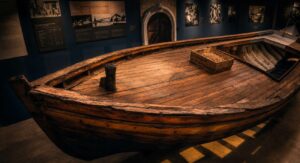
In the small blue museum on Alma Vivoda Street in Izola, there is a room few would expect to find in a fishing town. It is dedicated to Pietro Coppo, born in Venice at the end of the 15th century and resident for much of his life here in Izola, where he held public office and eventually died.
Coppo was one of the most rigorous cartographers of his time. His maps of Istria, drawn with remarkable precision for the period, remain a fundamental record for understanding how the Venetians saw—quite literally—this territory.
Izola, a border outpost
In Coppo’s time, Izola had already been part of the Republic of Venice for two centuries—and would remain so until the fall of the Serenissima in 1797. Like many coastal towns in Istria, it occupied a delicate position: a strategic trading port and administrative outpost, but also a crossroads of different languages and cultures—Venetian, Slavic and Austrian—which had coexisted here for centuries without ever fully merging.
A cartographer who chooses to live in such a place does more than measure distances: he learns to read a contested landscape, shaped by shifting borders and overlapping identities.
The hinterland Coppo mapped by hand
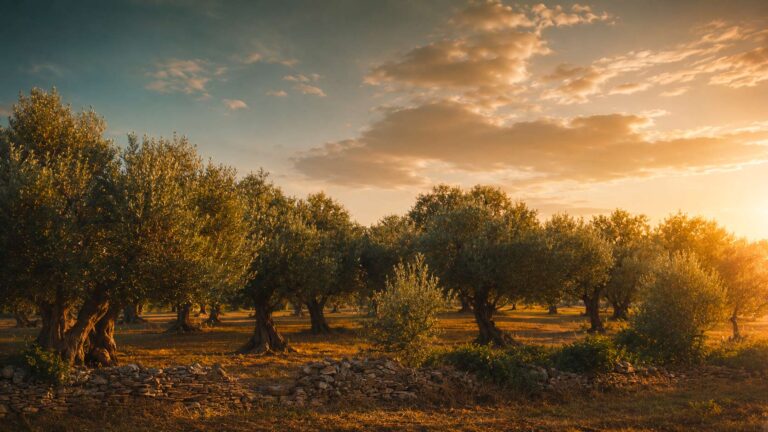
There is something significant about a cartographer choosing to live precisely where the coast meets the hilly hinterland. From Izola, the landscape changes within minutes: the sea gives way to terraced hills, centuries-old olive groves and vineyards climbing the flysch slopes. It is the same landscape Coppo mapped by hand, line by line, without satellites or aerial surveys—relying only on direct observation and patience.
Climbing towards Malija, among olive groves overlooking the gulf, lies the grove of Vanja Dujc, one of Europe’s most highly awarded olive oil producers. Like Coppo five centuries before him, he too has learned to read the land piece by piece—not with pen and ink, but with rake and press, distinguishing twelve olive varieties to create his blends.
An olive mill, a winery, the same land
A little further on, in Korte, a 19th-century olive mill is now home to Hiša Torkla, where the grill has replaced the press but the rural spirit remains intact. The kitchen does not chase trends: it works with what the land offers, season by season.
And descending towards Koper, in Gažon, the Rojac family has been growing vines for more than four hundred years on the same terraces Coppo would have seen from Izola—the same Renero that the Serenissima taxed three times more heavily than other wines, a sign of a quality already recognised at the time. Four centuries of agricultural continuity in a land that has changed flags many times, yet never stopped growing the same grapes.
To travel through this hinterland today, from Izola to the hills above Koper, is in some ways to retrace the gaze of a cartographer who was among the first to bring order to a complex borderland contested by different cultures. The difference is that today, instead of paper and ink, there is a plate on the table, a glass of wine, a spoonful of olive oil—the same land, read through different tools.
An anniversary, a rediscovered map
In 2025, the 500th anniversary of Coppo’s map was marked across the region with a series of events—an exhibition travelling between Piran and Izola, and an international conference at Manzioli Palace bringing together scholars from Slovenia, Italy and Croatia. For one day, the original map, preserved at the Maritime Museum in Piran, returned to Izola, where it was probably drawn: a small symbolic gesture—the map returning to the place it depicted.
It is a detail that says something larger about this territory: memory can be preserved, but it only stays alive when someone continues to move through it. Whether it is a cartographer with his pen or a traveller with a car, the gesture is the same: crossing Istria piece by piece, in order to truly understand it.
You can find the full route in the itinerary Green Istria: from Izola to the hills of Koper.