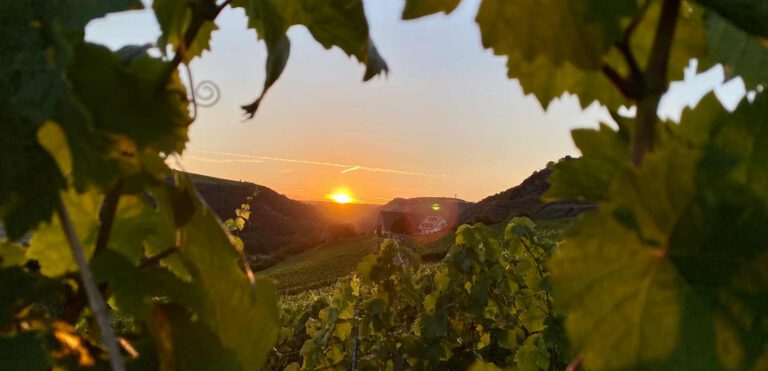
There is a precise moment when you realise you have crossed the border between Italy and Slovenia in the Collio. It is not the road sign, nor the language on the shop fronts. The landscape is a seamless continuation of the Gorizia Collio. Were it not for the road signs in Slovene, you might not even realise you had crossed into another country.
The same rolling hills, the same ponca soil, the same way of planting and tending the vineyards. Only here it is called Brda, a word that simply means “hills.”
A Border That Doesn’t Divide
Sometimes borders draw lines that may make sense on a geopolitical map, yet lose all meaning once you are actually standing in the landscape. This is exactly the case along the Collio border between Italy and Slovenia. There are no mountains or rivers separating the two countries, and the gentle hills roll seamlessly from one side to the other, without any visible interruption.
And yet, for decades, this was the border — the border that separated Western Europe from the Communist bloc. Families who owned land on both sides suddenly found themselves divided overnight. Wineries producing the same wines from the same soil suddenly found themselves operating in two different countries.
Today, that border has effectively disappeared — at least in practical terms. You can cross it without noticing, moving from one country to the other along roads that wind through the same vineyards and villages. What was once a dividing line has become little more than a detail on a map. Yet Brda has preserved its own identity — Slovene, neither Italian, Habsburg nor Venetian One of the few regions in this part of Europe whose character was not shaped by the Serenissima. While Venice influenced neighbouring territories for centuries, Brda followed a different path, developing an identity rooted in its own language, traditions and landscape.
What to See in Brda: Šmartno and the Medieval Villages of the Slovene Collio
The medieval village of Šmartno has preserved the atmosphere of the past almost intact. You enter through a gate in the ancient walls, and the world seems to shrink in scale — narrow lanes, stone houses and silence. Between six and eight in the evening, when the sun hangs low and its grazing light washes across the vineyard-covered hills, the landscape becomes almost impossible to describe.
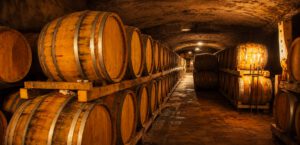
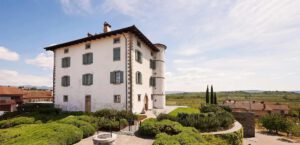
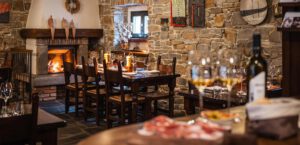
This is where you’ll find Hiša Marica — a restaurant serving seasonal cuisine that changes week by week, with tables set along the village’s stone-paved lanes. Nearby stands Gredič Castle, home to a Michelin-recognised restaurant and one of the most comprehensive wine cellars in the entire Collio region. In Ceglo, you’ll find Movia Winery — more than three centuries of winemaking history, a pioneer of natural wines, and tastings served on a panoramic terrace overlooking the rolling hills of Brda.
Rebula and the Cherry Trees
Goriška Brda is steeped in a winemaking tradition that dates back to pre-Roman times. Its signature grape is Rebula. Although originally introduced from Greece, it has been cultivated here for more than 750 years and still accounts for roughly a quarter of the region’s wine production.
But Brda is not only about wine. In spring, the cherry trees come into bloom and transform the hills into something almost impossible to describe. White blossoms spread across the landscape, softening the vineyards and stone villages beneath them, while the entire region seems suspended between winter and summer. For a few brief weeks, Brda becomes one of the most beautiful landscapes in Central Europe. Spring is the finest time to visit — before the arrival of the summer crowds, when the light is still soft and white blossom drifts among the vineyard rows.
Brda is best explored by bicycle or by car, without a strict plan and without rushing. Brda lies just twenty minutes from the Italian Collio and forms part of The Golden Thread of Malvasia itinerary, which continues from these hills towards the Karst and, eventually, the coast of Istria.
Brda can be visited year-round, but spring — from mid-March to late April — is undoubtedly its most spectacular season, when cherry trees bloom among the vineyards and the hills seem to turn white. In summer, the region comes alive with wine and cultural events, including the Festival of Rebula, a celebration of Brda’s signature grape and the winemaking traditions that have shaped these hills for centuries. Those who choose to stay a little longer will find farm stays and boutique B&Bs scattered among the vineyards — the perfect way to experience the region at the unhurried pace it deserves. From Gorizia, Brda is just a twenty-minute drive away, with no motorways in between — only quiet roads winding through a landscape that changes colour with the seasons.
Brda is not a place to rush through. It is a place that reveals itself through return visits — each season bringing its own light, each winery its own story to tell.